What a Marketing Manager should get from their Google Ads agency
A Google Ads report should show what's being done, whether it's working, what comes next and whether you're getting your money's worth.

On this page
Who this helpsMarketing and Ecommerce Managers at established online stores in New Zealand and Australia, working with an agency.
A Marketing Manager can read their agency's whole monthly report and still not know whether the ads are working. There's plenty in it: impressions, clicks, click-through rate, and a list of the keywords added and ads changed. Those are mostly the numbers the agency uses to judge its own work, so the Marketing Manager is left to work out for themselves whether the ad spend is worth it.
The report should answer that for them. A Marketing Manager should finish reading it knowing how the ads are doing and what comes next, so their time with the agency goes on deciding what to test.
You don't ask your builder to count the nails
Some agencies will argue that it's important to show a Marketing Manager every number they use to judge ad performance. More numbers and more explanation, they believe, mean more transparency.
I see it differently. Think about hiring a builder to work on a house. Nobody expects a weekly report on how many nails went in. They trust the builder with the nails, because that's the job they hired them to do. What the homeowner wants to know is whether the job is on schedule and on budget, and they want the builder to come to them with a recommendation when there's a decision only they can make.
Marketing is the one area where we expect the opposite. Marketing Managers end up hearing why clicks are down 5% on last month, when it made no difference to the business. An agency is paid to look at the results of its work, say what it sees, and recommend what to do next. The activity in between only needs reporting when it has a material effect on performance.
Nobody expects a weekly report on how many nails went in.
Know the answers before anyone asks
A Marketing Manager is responsible for the ad spend, so they need answers ready when their boss or anyone else in the business asks about the ads. The questions usually come down to four:
What are we doing?
Is it working?
What are we doing next?
And most importantly, are we getting our money's worth?
A Marketing Manager should be able to answer these at any point in the month, without opening the report. That takes their own view of the ads, which starts with the numbers: the KPIs, how the business is doing against them, the revenue marketing brings in, and the key numbers for the other activities they run.
The agency's report is a working document between the agency and the Marketing Manager, and it doesn't need to be passed on to anyone. A good agency uses it to help the Marketing Manager build their own view.
What the report should give the Marketing Manager
What are we doing? The work the agency is doing, and what each piece of it is meant to achieve.
Is it working? Whether the ads are contributing to the business objectives they're aimed at, and how the KPIs the business and the agency agreed to measure them are moving. The objective might be a bigger share of a category, more orders, a higher average order value, growth in one region, or simply ads that make a profit. Where a KPI is about a category or a region, the report should show that category's or region's transactions and revenue, compared with last month and the same month last year. When a result isn't clear, the report should say how sure the agency is about it.
The ad numbers that show those KPIs moving are:
- ROAS: the sales the ads bring in for every $1 spent.
- Conversions: for most stores, the number of orders.
- Conversion value: what those orders are worth.
- Cost per click: what the auction is charging, which affects what the ads can return.
What are we doing next? A recommendation, with a clear view behind it. A list of options for the Marketing Manager to choose from doesn't count, and neither does busywork, like rewriting the ad copy on ads whose economics don't work.
Are we getting our money's worth? ROAS only goes part of the way here. It measures the sales from the ads, but it doesn't show whether those sales made a profit. When the business knows its margins, the report should also show profit on ad spend (POAS). The agency needs those margins to set a target that makes the business money.
| The question | What the report should show |
|---|---|
| What are we doing? | The work the agency is doing, and what each piece of it is meant to achieve. |
| Is it working? | Whether the ads are contributing to the business objectives, and how the agreed KPIs are moving: ROAS, conversions, conversion value and cost per click. |
| What are we doing next? | A recommendation, with a clear view behind it. |
| Are we getting our money's worth? | ROAS, plus profit on ad spend (POAS) when the business knows its margins. |
If the KPIs were never agreed, that's the first conversation to have with the agency. A Marketing Manager whose report doesn't answer all four questions is entitled to ask for it, although a good agency shouldn't need to be asked.
The detail is there when the Marketing Manager wants it
A Marketing Manager often wants to know how the agency reached a decision. That's reasonable, because they're responsible for the work and may have to explain it. A good agency should go into as much detail as the Marketing Manager wants.
When the Marketing Manager reports on the work to others in the business, most of that detail can stay behind. If the agency changed the bid strategy to bring down the cost per click, the useful summary is that the agency is testing different ways of bidding to get more results for the ad spend.
Ask for more when it's uncertain and it is important
"Can we get more information on this?" is one of the questions I hear most after a report, and I'm glad when it comes up, because it often brings out something neither side knew was important. More information is worth asking for when nobody is sure yet what's happening and the impact is high. It's also worth asking for when the Marketing Manager knows something from inside the business that the agency doesn't, such as a product line being dropped. The extra information lets both sides work out what that means for the ads.
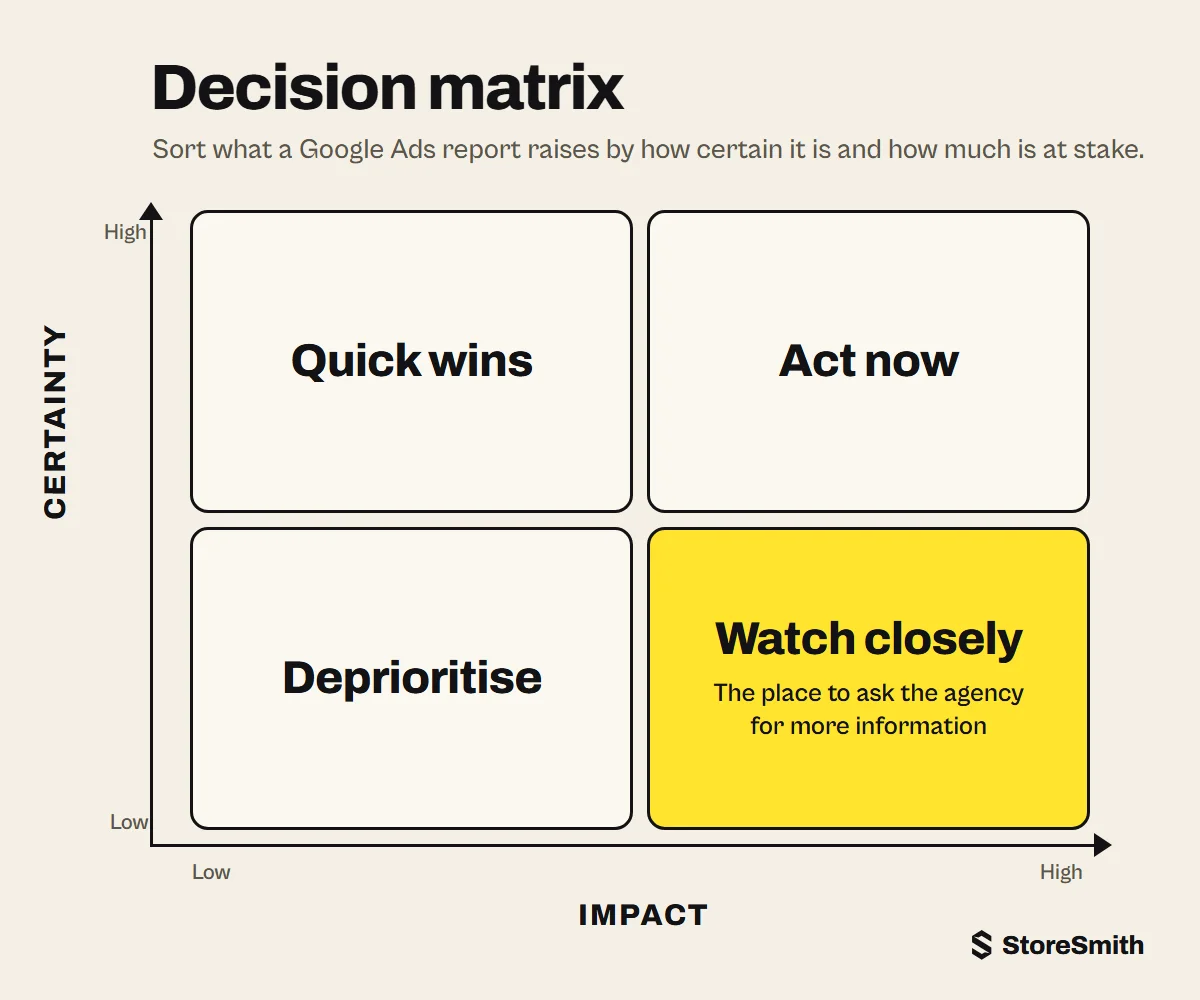
The matrix sorts anything a report raises by how certain we are and how much is at stake.
- Act now (certain, high impact): the agency brings a recommendation and the Marketing Manager decides quickly. For example, cost per click rises and ROAS falls below target, so the agency changes the bid strategy or the ROAS target.
- Quick wins (certain, low impact): the agency just does it, and it doesn't need to come up in the meeting. For example, fixing a spelling mistake in a product title.
- Watch closely (uncertain, high impact): this is where requests for more information belong. For example, sales from one category fall, and it isn't yet clear whether the cause is the ads, the price or the season.
- Deprioritise (uncertain, low impact): leave it out of the report. Age and gender breakdowns are a common example. Nobody acts on them, but they appear every month, and each one is more for the Marketing Manager to read before reaching the numbers they actually use.
Before the next meeting, a Marketing Manager can sort what the report raises into the four boxes. Most of the meeting should go on "act now" and "watch closely".
Tell the agency what's changed in the business
A Marketing Manager is much closer to the business than any agency. They know when prices change, when stock runs low, when a promotion is coming, or when a new range is about to launch.
They also run activity in other channels that can show up in the ads. A top-of-funnel push on social, for example, can bring more brand ad clicks, and an agency that doesn't know about the push can't tell where the extra clicks came from.
Once the agency knows what's changed, it can decide whether the ads need to change too, and whether that's a tactical adjustment or a bigger change of strategy. A promotion, for example, can justify a higher budget while it runs. A range that's running low on stock may need its ad spend cut, so the budget goes to products the business can still supply. The best work I've done for clients has been where the Marketing Manager is properly involved in how the business is run. Test ideas from the Marketing Manager are part of that, and they're most useful when they come with the result the Marketing Manager wants to change, such as "we think free shipping over $100 will lift the average order value".
Let the agency lead, and disagree directly
A Marketing Manager gets the most from an agency when they let it lead the process. They stay in charge of the decisions, and each decision comes to them with a strong recommendation from people who specialise in the work. That specialist judgement is only useful when the Marketing Manager trusts it.
When a Marketing Manager disagrees, they should say so directly. If I'm wrong, I want to know as quickly as possible, because carrying on with something that's wrong only produces bad results. When the agency and the Marketing Manager fix things together and the results improve, nobody remembers having their feelings hurt.
After the meeting, get internal agreement
Once the Marketing Manager and the agency have agreed what to do, the Marketing Manager can speed things up by getting agreement from the people inside the business the work depends on. Advertising rewards testing and acting, so the sooner a change goes live, the sooner the business sees what it does.
A Marketing Manager who knows their numbers and can explain what the ads are doing is also well placed to ask for the authority to approve changes themselves. Not needing sign-off for each change keeps the testing moving.
- The reportHow the ads are doing and what comes next.
- Sort itPut what the report raises into the four boxes.
- MeetDecide on the agency's recommendation, and tell it what's changed in the business.
- Get agreementLine up the people inside the business the work depends on.
- Go liveThe sooner a change goes live, the sooner the business sees what it does.
Second opinions are fine
If a Marketing Manager wants to know whether their agency is doing a good job, they can ask another agency to review the account. That usually means giving the second agency access to the Google Ads account so it can look through the campaigns and settings. We don't mind when clients do this. A good agency should be confident in its work, and a second opinion may confirm it.
A Marketing Manager can also judge an agency by whether its opinions and explanations make sense to them. If they don't, the Marketing Manager should ask, and making them clear is the agency's job.
Before the next agency meeting, a Marketing Manager can try answering these without opening the report: what are we doing, is it working, what are we doing next, and are we getting our money's worth? If they can't, that's the first thing to raise with the agency.